

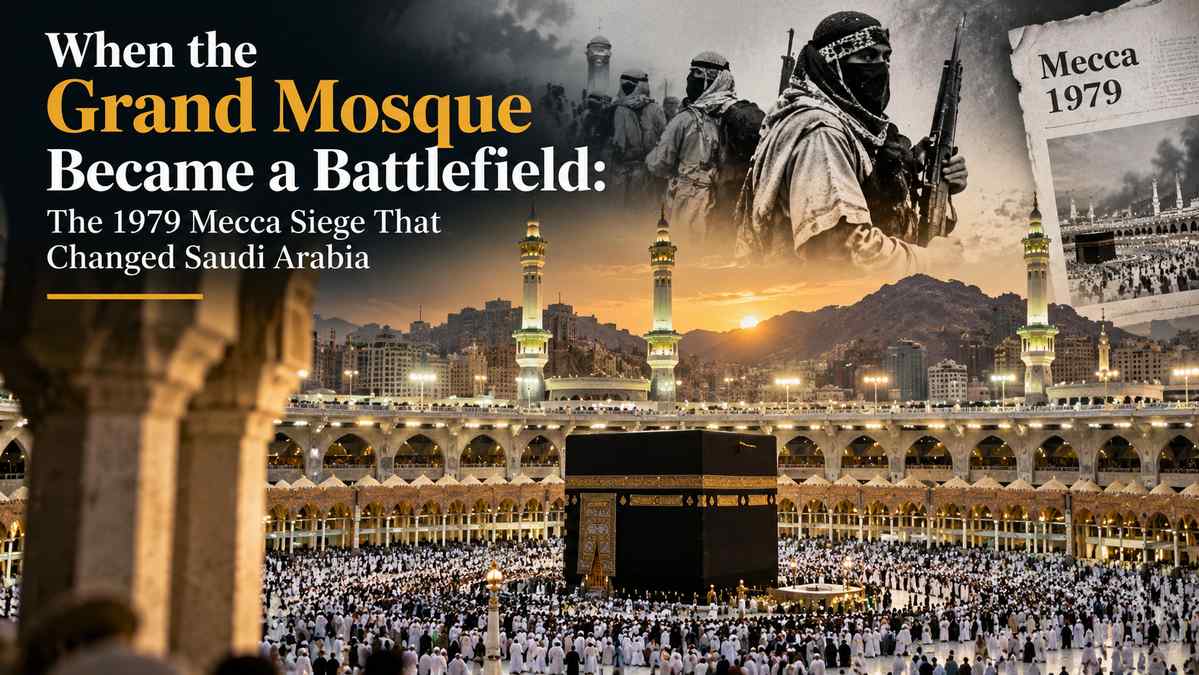
For a brief period this week, an emergency warning in Mecca brought an uncomfortable question back into focus: what happens when violence approaches a place regarded by more than a billion Muslims as sacred?
Saudi Arabia said its air defenses intercepted a Houthi drone south of Mecca before it entered restricted airspace. The Houthis denied targeting the holy city.
The circumstances are completely different from what happened nearly 47 years ago.
Yet the latest security scare has revived memories of one of the most extraordinary episodes in modern Middle Eastern history — the day hundreds of armed men seized the Grand Mosque surrounding the Kaaba and held Islam’s holiest site for roughly two weeks.
The 1979 Grand Mosque seizure was more than a hostage crisis or armed rebellion.
Its consequences would help reshape Saudi society for decades.
Dawn Prayer Turns Into an Armed Takeover
It was November 20, 1979.
Thousands of worshippers had gathered at Masjid al-Haram in Mecca for the Fajr, or dawn, prayer.
Then the atmosphere changed.
Armed followers of Juhayman al-Utaybi, a former member of the Saudi National Guard and a religious preacher, moved through the enormous mosque complex.
Weapons had reportedly been smuggled into the sanctuary, including in coffins brought into the mosque under the appearance of funeral rituals.
Once the weapons were distributed, militants occupied key positions around the complex.
Entrances were secured.
Gunmen positioned themselves in strategically useful locations.
And worshippers who had arrived expecting an ordinary morning of prayer suddenly found themselves inside an armed uprising.
The Rebels Announce the Arrival of the Mahdi
The takeover was driven by an intensely religious and political worldview.
Juhayman’s followers announced that his brother-in-law, Mohammed Abdullah al-Qahtani, was the Mahdi — the divinely guided figure whose appearance is anticipated in Islamic eschatological traditions.
The timing was significant.
November 20, 1979 corresponded with the beginning of the Islamic year 1400.
The rebels presented their action as a religious uprising and demanded allegiance to al-Qahtani.
But underneath those religious claims was also a political challenge to Saudi Arabia’s rulers.
Juhayman and his followers believed the kingdom had moved too far toward modernization and Western influence. They accused the Saudi establishment of corruption and abandoning what they regarded as proper Islamic principles.
Oil wealth had transformed Saudi Arabia rapidly.
New infrastructure, technology and foreign connections were changing everyday life.
For Juhayman’s movement, those developments represented moral decline rather than progress.
Taking over the Grand Mosque was their attempt to challenge that transformation from inside the kingdom’s religious heart.
Why Saudi Forces Faced an Extraordinary Problem
Saudi authorities suddenly faced a security nightmare unlike an ordinary insurgency.
The militants were occupying one of the most sacred places in Islam.
The Grand Mosque is not simply another strategically important building.
It surrounds the Kaaba, toward which Muslims around the world face during their daily prayers.
Fighting within Mecca’s sacred precinct is subject to profound religious restrictions.
Saudi security personnel stationed around the mosque were also not prepared for hundreds of heavily armed militants occupying defensive positions throughout the enormous complex.
Initial attempts to regain control encountered fierce resistance.
Militants occupied minarets and other elevated positions, giving them substantial tactical advantages.
Saudi forces surrounded the mosque, but simply bombarding the complex was unthinkable.
The government needed both a military solution and religious authorization.
Religious Authorities Authorize Force
Saudi Arabia’s senior religious scholars eventually issued a ruling permitting authorities to use force to remove the armed occupiers.
That decision opened the way for a much larger operation.
Saudi forces began fighting their way through sections of the mosque.
But retaking the visible parts of the complex did not end the crisis.
The Grand Mosque contained underground rooms, chambers and passageways.
As Saudi troops advanced, surviving militants withdrew into those spaces.
The battle effectively moved underground.
And that created another problem.
Troops entering narrow underground passages could face gunfire from defenders who knew their positions and had prepared for confrontation.
Saudi Arabia needed another approach.
France Enters the Story
This is where one of the most famous — and sometimes exaggerated — parts of the story begins.
Saudi Arabia sought foreign technical assistance, including help from France.
Accounts have long associated specialists connected with France’s GIGN counterterrorism force with planning the operation against the remaining militants.
But the episode has accumulated legends over the decades.
It is sometimes described as if French commandos simply entered Mecca and personally fought their way through the Grand Mosque.
The reality is more complicated.
Foreign involvement was highly sensitive because non-Muslims are prohibited from entering Mecca, and historical accounts differ on exactly how French assistance was provided.
The safer conclusion is that French specialists supplied technical advice that contributed to Saudi planning for the final phase of the operation.
The actual fighting to retake the mosque was carried out by Saudi forces.
The Battle Goes Underground
By this stage, the siege had become a brutal contest inside confined spaces.
The remaining militants were entrenched underground.
Saudi forces drilled openings into sections of the subterranean complex.
Gas was then introduced as part of efforts to force or incapacitate the militants holding out below.
The tactic helped Saudi forces overcome resistance in positions that were extremely difficult to assault directly.
After roughly two weeks of fighting, the occupation finally collapsed.
Juhayman was captured alive.
Al-Qahtani, the man his followers had proclaimed the Mahdi, was killed during the fighting.
The Grand Mosque was back under Saudi control.
But the cost was substantial.
How Many People Died?
Exact figures and descriptions vary across historical accounts.
Saudi authorities subsequently reported significant casualties among security forces, militants and civilians.
The fighting had transformed one of the world’s most sacred religious spaces into a battlefield involving gunfire, explosions and prolonged combat.
The psychological impact was perhaps even greater.
Saudi Arabia’s rulers had long linked their legitimacy to their role as custodians of Islam’s two holiest mosques.
Now an armed movement emerging from within Saudi religious society had managed to occupy the Grand Mosque itself.
That exposed a vulnerability no government could easily ignore.
Juhayman’s Capture Did Not End the Story
Saudi authorities moved rapidly against surviving members of the movement.
Juhayman and dozens of captured followers were tried.
On January 9, 1980, Juhayman and 62 other convicted rebels were executed in cities across Saudi Arabia.
The uprising had been crushed.
But some of its ideas would prove harder to bury.
The Saudi leadership had to confront the fact that the rebels’ criticism of modernization resonated with portions of the kingdom’s deeply conservative religious establishment.
The government’s response therefore extended far beyond security measures.
Saudi Society Became More Conservative
This is where the long-term significance of 1979 becomes particularly important.
After the siege, Saudi authorities strengthened relationships with conservative religious institutions and increased enforcement of strict social rules.
Religious authorities gained greater influence over parts of public life.
Entertainment and public behavior faced tighter restrictions.
Gender segregation became more extensive in many settings.
The kingdom was already conservative, and historians debate exactly how much of the subsequent shift can be attributed specifically to the Grand Mosque seizure rather than other events occurring in 1979, including the Iranian Revolution.
But the siege became a major turning point in Saudi political and social history.
The government had defeated Juhayman’s movement militarily while also responding to the religious challenge it represented.
Why 1979 Still Matters in Saudi Arabia
Decades later, Crown Prince Mohammed bin Salman would explicitly describe 1979 as an important turning point while promoting a dramatically different direction for the kingdom.
Saudi Arabia has since loosened many social restrictions.
Women gained the right to drive.
Cinemas reopened.
Large concerts and entertainment events became common.
Tourism expanded.
The powers of the religious police were curtailed.
These changes are part of a much broader economic and social transformation associated with Vision 2030.
Seen from that perspective, the Grand Mosque siege belongs not only to Saudi Arabia’s past.
It helps explain part of the country’s modern transformation.
Today’s Mecca Alert Is Very Different
The temptation to draw a straight line between 1979 and today’s tensions should be resisted.
The two situations are fundamentally different.
In 1979, an armed movement physically occupied the Grand Mosque from inside Saudi Arabia.
In September 2026, Saudi authorities issued an emergency warning amid renewed regional fighting and later said an alleged Houthi drone had been intercepted south of Mecca before entering the holy city’s restricted airspace.
The Houthis deny that Mecca was their intended target.
There has been no occupation of the city or the Grand Mosque.
Yet the reaction illustrates why any perceived threat involving Mecca carries extraordinary significance.
The Siege That Outlived the Men Who Started It
The most remarkable thing about the Grand Mosque seizure may therefore not be how it ended.
It is how long its consequences lasted.
Juhayman and his followers controlled the mosque for roughly two weeks.
But the political and social shock produced by those two weeks influenced Saudi Arabia for decades.
The siege challenged the monarchy, exposed security weaknesses and forced the government to confront a radical religious movement emerging from within its own society.
Saudi forces eventually retook the Grand Mosque.
Juhayman was captured.
His movement was dismantled.
But history did not simply return to where it had been on the morning of November 20, 1979.
That is why the episode remains so important nearly half a century later.
The gunmen held Islam’s holiest mosque for days. The consequences of their uprising lasted for generations.