

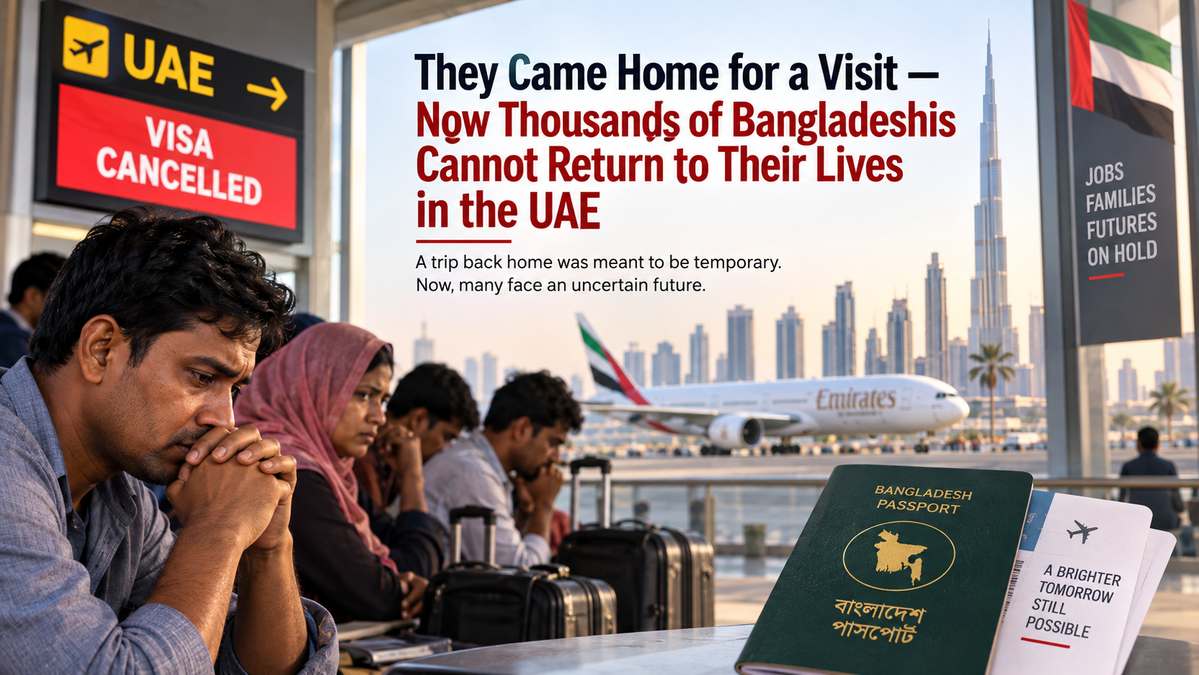
For thousands of Bangladeshis, a temporary trip home has unexpectedly become an indefinite stay.
Workers and business owners who left the United Arab Emirates for short visits to Bangladesh have discovered that their residence visas were cancelled while they were away, preventing them from returning to jobs, businesses and, in some cases, family members still living in the Gulf state.
Bangladeshi officials and expatriate groups say the number of reported cases has risen sharply, with ministry sources putting the latest figure at around 4,800 people.
What remains unclear is why so many visas have been cancelled.
The UAE has not publicly announced a single reason covering all of the affected Bangladeshis, leaving workers searching for answers while Dhaka attempts to resolve the problem diplomatically.
But behind the visa statistics lies a much larger story.
For migrant workers, permission to return to the UAE can determine whether a family keeps receiving an income, whether a business survives and whether years spent building a life abroad can continue.
A Short Visit Becomes a Long Separation
Many of those affected did not leave the UAE permanently.
They returned to Bangladesh temporarily.
Some came to see relatives. Others took ordinary leave from work.
Then messages and emails began arriving informing them that their UAE visas had been cancelled.
One of those affected is Abul Kalam Azad, who told The Daily Star that he had lived in the UAE for 27 years.
Azad returned to Bangladesh on April 7.
On July 24, he received an email saying his visa had been cancelled.
According to his account, the notification provided no explanation.
For someone who had spent nearly three decades building a life in the UAE, a single email effectively closed the door on his return.
Around 4,800 Cases Now Reported
The numbers surrounding the controversy have changed significantly.
In July, reports circulated suggesting that as many as 5,000 Bangladeshis had been affected.
Bangladesh’s State Minister for Foreign Affairs Shama Obaed Islam disputed that figure at the time, saying official information showed exactly 626 cases.
She also stressed that the cancellations were not limited to Bangladeshis.
Nationals from Pakistan, Nepal, Egypt, the Philippines and other countries had experienced similar problems.
By September, however, the reported number of Bangladeshi cases had grown substantially.
Expatriates’ Welfare and Overseas Employment Minister Nurul Haque Nur acknowledged that around 4,000 Bangladeshis had experienced visa cancellations.
Ministry sources subsequently put the number at approximately 4,800.
That changing figure is important because it explains why apparently contradictory numbers have appeared in different reports.
The earlier figure of 626 represented the cases officially identified at that stage in July. The much larger numbers reflect later reports as additional affected expatriates emerged.
Why Were the Visas Cancelled?
This is the question workers most urgently want answered.
And there is still no simple answer.
UAE residence rules can generally create problems when residents remain outside the country for extended periods, including more than six consecutive months in many circumstances.
But several Bangladeshis involved in the current dispute say they had been outside the UAE for only two or three months when their visas were cancelled.
That makes the ordinary six-month explanation insufficient for at least some reported cases.
Bangladeshi officials have previously mentioned issues including forged documents, termination of employment and violations of UAE rules as possible reasons affecting individual visa cases.
Officials have also urged expatriates to avoid illegal activities and sensitive or political social-media posts.
But those factors should not automatically be applied to every person affected.
No UAE statement has established that thousands of Bangladeshis lost their visas for one common reason.
Middle East Tensions Add Another Layer of Uncertainty
The cancellations are also taking place during an unusually tense period across the Middle East.
The continuing regional conflict has increased security concerns throughout Gulf states.
MS Shekil Chowdhury, chairman of the Centre for Non-Resident Bangladeshi, told The Daily Star that authorities had increased scrutiny amid regional instability and the US-Iran conflict.
Social-media activity and anything regarded as a potential security concern could attract greater attention, he said.
But Chowdhury also cautioned against assuming that those issues directly explain the mass cancellations.
That distinction matters.
The regional security environment may provide context for tougher scrutiny, but without an official UAE explanation, it would be premature to claim that the Iran conflict itself caused these visa cancellations.
Some Workers Have Far More Than Jobs at Risk
For many Bangladeshis, the UAE is not simply a place where they collect a salary.
It is where they have spent years — sometimes decades — building their lives.
One affected expatriate told The Daily Star that he owned two businesses in the UAE and that his wife remained there.
He said he had no criminal case or legal problem that could explain the cancellation.
Instead of returning to Dubai as planned, he found himself moving between offices in Bangladesh looking for somebody who could help him regain entry.
Cases like his illustrate why the phrase “visa cancellation” can sound deceptively administrative.
A cancelled document can mean separation from a spouse.
It can mean losing access to a business.
It can mean unpaid debts.
And for workers whose employers cannot wait indefinitely, it can mean losing a job altogether.
Bangladesh’s Remittance Economy Is Also Exposed
The consequences extend beyond individual workers.
More than 1.2 million Bangladeshis live in the UAE, making them one of the country’s largest expatriate communities.
Many work in construction, transportation, manufacturing and other industries.
Their earnings also flow back into Bangladesh.
Migrant workers support parents, spouses and children, repay loans, fund education and pay household expenses through the money they send home.
This makes remittances an important part of Bangladesh’s economy.
The broader Middle East conflict is already creating pressure on that system.
Bangladeshi migrants elsewhere in the region have reported job losses, unpaid salaries and business disruptions, while overseas employment numbers fell sharply during the early months of the conflict.
If visa restrictions reduce access to one of Bangladesh’s major Gulf employment markets, those pressures could become more severe.
Migration Often Begins With Debt
There is another reason the stranded workers face particular financial pressure.
Many Bangladeshis borrow significant sums to secure overseas employment.
Recruitment fees, agents, travel and documentation can leave workers carrying debt before they earn their first salary abroad.
The financial logic works only if the overseas income continues.
If a worker travels home and suddenly cannot return, that calculation can collapse.
The salary stops.
The debt remains.
And the family that depended on monthly remittances may suddenly lose its main source of income.
This helps explain why affected workers are asking Bangladesh’s government for more than diplomatic intervention.
Stranded Workers Want Financial Assistance
Around 350 affected Bangladeshis gathered at the National Press Club in Dhaka on September 7 seeking government action.
Their demands included financial assistance and rehabilitation.
Affected expatriates have sought monthly support of between Tk 15,000 and Tk 20,000 for workers and their families while the problem remains unresolved.
They have also asked the government to help them find employment in other countries if returning to the UAE becomes impossible.
The demands reveal how quickly an immigration problem can become a social-welfare problem.
Workers who previously supported their households from abroad are now asking their government to support them at home.
Dhaka Is Seeking a Diplomatic Solution
Bangladesh says it is engaging UAE authorities over the issue.
Nurul Haque Nur has said the government is aware that many affected Bangladeshis have businesses and shops in the Emirates and that diplomatic efforts are underway.
Earlier, Bangladesh had also submitted individual cases to UAE authorities seeking visa renewals.
Affected expatriates have demanded progress by September 22.
Whether the UAE will reconsider large numbers of cancellations remains uncertain.
Much may depend on why individual visas were cancelled in the first place.
If the cases involve different circumstances — employment termination in some, documentation problems in others and security or administrative concerns elsewhere — there may be no single solution covering everyone.
The Problem Is Bigger Than 4,800 Visas
The most important part of this story is therefore not the precise number.
It is what those numbers represent.
Thousands of people left a country where they had jobs, businesses and families believing they would soon return.
Instead, many discovered that the legal bridge connecting their lives in Bangladesh and the UAE had disappeared while they were away.
For Bangladesh, the episode highlights the vulnerability that comes with depending heavily on overseas employment.
For the affected workers, the issue is much more immediate.
They are not simply waiting for new visas.
They are waiting to learn whether the lives they spent years building in the UAE are still there for them to return to.
Until UAE authorities provide greater clarity or individual cases are resolved, thousands remain caught between two countries — at home in Bangladesh, but separated from the jobs, businesses and families that made the UAE home as well.