

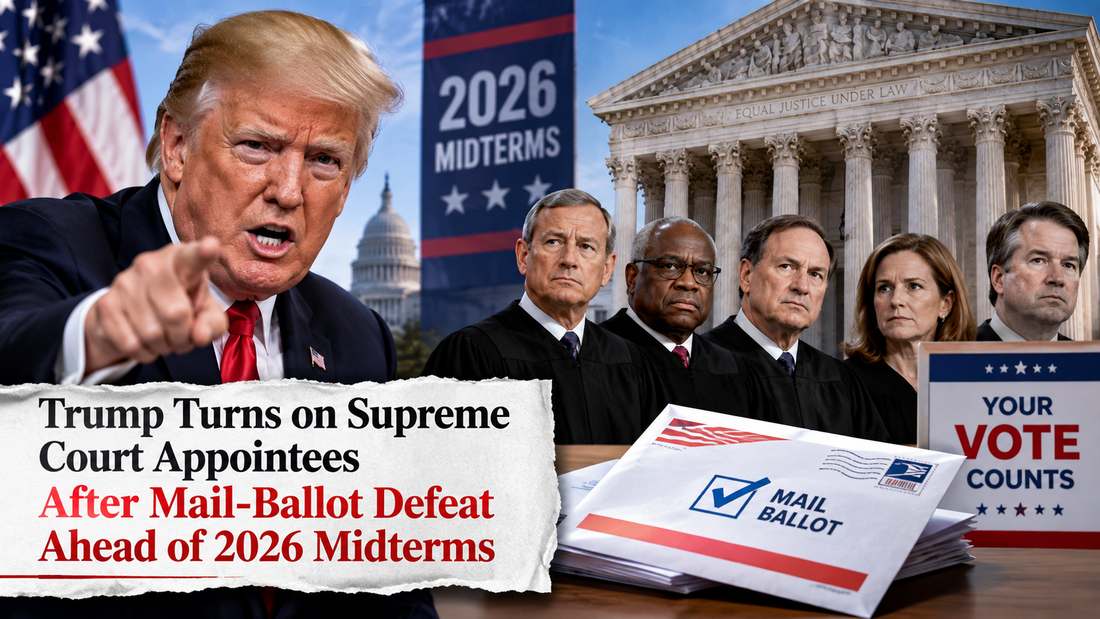
President Donald Trump has launched an unusually personal attack on the US Supreme Court after it refused to allow his administration to impose new mail-ballot restrictions ahead of the November midterm elections.
But behind Trump’s angry response lies a larger constitutional story.
During his first presidency, Trump appointed three Supreme Court justices and helped create the Court’s 6-3 conservative majority. Yet once confirmed, Supreme Court justices receive lifetime appointments and do not answer to the president who selected them.
That independence is now creating an increasingly public clash between Trump and a Court he played a major role in shaping.
The latest confrontation erupted after the justices declined to let a controversial US Postal Service rule governing mail ballots take effect before the November 3 elections.
Trump responded by questioning the very justices he had helped put on the bench.
“These are not the people I interviewed to serve on the United States Supreme Court,” Trump wrote on Truth Social, describing them as “merely a shell of their original selves.”
He did not identify individual justices in that statement.
However, Trump’s three Supreme Court appointments during his first term were Neil Gorsuch, Brett Kavanaugh and Amy Coney Barrett.
What Did the Supreme Court Actually Decide?
The dispute centers on new Postal Service requirements affecting mail ballots.
The proposed system would require states to provide voter-specific information and use USPS-approved ballot envelopes equipped with tracking barcodes.
Under the rule, the Postal Service could refuse to send certain ballots when the required standards were not satisfied or when voters did not appear on submitted lists.
The Trump administration argued that the changes were intended to strengthen election security and prevent fraud.
Democratic-led states and voting-rights organizations challenged the rules.
They argued that the federal government was attempting to interfere with powers traditionally exercised by states and warned that implementing a complicated new system so close to an election could prevent legitimate ballots from reaching voters.
Lower courts blocked implementation.
The administration then went to the Supreme Court seeking permission to enforce the rules before the midterms.
The Court declined.
Timing Became a Critical Issue
One of the most important details in the ruling is that the Supreme Court did not necessarily resolve every underlying legal question surrounding the Postal Service’s authority.
Timing mattered.
Justice Brett Kavanaugh indicated that election officials did not have enough time to reasonably implement the new requirements before voting.
That distinction is important because it means the decision should not simply be described as the Supreme Court permanently rejecting every element of Trump’s mail-voting policy.
Instead, the immediate result is that the restrictions cannot be implemented as planned for the approaching midterm elections.
The legal questions surrounding federal authority over mail-ballot procedures could continue beyond November.
Trump Calls the Decision Political
Trump reacted furiously.
He described the ruling as “horrible” and “highly political” and accused the Court of being influenced by the political left.
He also argued that the decision would hurt Republicans.
“It is a big loss for Republicans, and America itself,” Trump wrote.
Attorney General Todd Blanche subsequently said the administration would comply with the Supreme Court’s decision.
Trump’s criticism is notable because conservatives currently hold six of the Court’s nine seats.
Three of those justices owe their appointments directly to Trump.
Yet only Justices Clarence Thomas and Samuel Alito publicly dissented from the Court’s decision. Trump subsequently praised the pair.
Why Mail Voting Remains So Contentious
Trump has criticized voting by mail for years.
Following the 2020 presidential election, he repeatedly alleged widespread election fraud, although those claims were rejected in numerous court proceedings and reviews, and evidence has not established widespread mail-ballot fraud capable of producing the result he alleged.
Trump has nevertheless continued arguing that mail voting creates opportunities for abuse.
There is also an unusual contradiction in his relationship with the voting method.
Trump himself has voted by mail, including recently in Florida’s Republican primary.
Mail voting is also widely used across the United States, although individual states have very different rules governing eligibility, deadlines and ballot processing.
The Constitution Complicates Trump’s Plan
Another major issue is who has authority over elections.
The US Constitution gives states significant responsibility for administering elections, while Congress also has constitutional powers over federal election rules.
The legal challenges argued that the executive branch and Postal Service cannot independently impose requirements that effectively alter how states conduct elections without appropriate congressional authority.
US District Judge Indira Talwani previously blocked the Postal Service rule, writing that the executive branch does not possess inherent authority over voting rules.
A second federal judge also blocked the restrictions shortly before the Supreme Court acted.
That broader constitutional dispute is one reason the case extends beyond the political argument over whether mail voting is secure.
It also concerns the limits of presidential and administrative power.
A President Confronts the Court He Helped Build
Perhaps the most interesting element of the controversy is Trump’s relationship with his own Supreme Court appointments.
Presidents choose nominees partly because of their judicial philosophy and legal records.
But confirmation does not create a continuing relationship of political loyalty.
Supreme Court justices serve for life unless they retire, resign or are removed through impeachment.
They do not have to run for reelection.
And presidents cannot dismiss them because of an unfavorable ruling.
That structure is intentional.
It is designed to give the judiciary independence from both Congress and the White House.
Trump’s complaint that these were not the people he remembered interviewing therefore highlights a fundamental feature of the American constitutional system: appointing a justice gives a president enormous influence over the Court’s composition, but not control over that justice’s future decisions.
This Is Not Trump’s First Clash With His Appointees
The mail-ballot case is part of a broader pattern.
Trump has also criticized Supreme Court decisions involving his administration’s tariffs and efforts concerning birthright citizenship.
In February, the Court struck down sweeping global tariffs that Trump had imposed using emergency powers.
Gorsuch and Barrett joined the majority in that case, prompting particularly sharp criticism from Trump.
He revived those complaints following the latest mail-ballot decision.
At other times, however, the conservative Court has delivered significant victories for Trump and Republican-backed policies.
That mixed record demonstrates why describing the Court simply as either “pro-Trump” or “anti-Trump” can obscure what is actually happening.
The justices consider separate legal disputes involving different statutes, constitutional questions and procedural circumstances.
The Midterms Raise the Stakes
The timing makes the mail-ballot dispute particularly significant.
Americans are scheduled to vote in congressional elections on November 3.
Control of Congress is at stake, and Republicans currently hold narrow majorities.
Mail voting has also become increasingly polarized in recent election cycles.
Surveys have generally found Democratic voters more likely than Republicans to use mail ballots, although voting patterns vary considerably by state and election.
That means changes to mail-ballot rules can have political consequences even when presented as administrative or election-security measures.
Trump explicitly framed the Supreme Court ruling as a loss for Republicans.
Election officials, meanwhile, have stressed the practical dangers of making major procedural changes when preparations for voting are already underway.
Judicial Independence Becomes the Bigger Story
Trump’s comments have transformed what might otherwise have remained a technical dispute over Postal Service rules into a broader argument about the relationship between the presidency and the Supreme Court.
The president clearly expected a different result from a Court whose conservative majority he helped establish.
But Supreme Court appointments are not political contracts.
Gorsuch, Kavanaugh and Barrett were nominated by Trump, but their constitutional authority does not come from continuing presidential approval.
Once confirmed, they became members of an independent branch of government.
That makes Trump’s remark—”not the people I interviewed”—particularly revealing.
It captures the frustration of a president discovering one of the limits built into the American system of government.
A president can transform the Supreme Court for a generation through appointments.
What a president cannot do is guarantee how those justices will rule once they take their seats.
The Fight Is Far From Finished
For the November midterms, the immediate consequence is relatively straightforward: the Trump administration cannot implement the disputed Postal Service restrictions under the blocked rule.
But the broader fight over mail voting is unlikely to disappear.
Trump continues to argue that tighter restrictions are necessary for election integrity, while voting-rights organizations and Democratic officials argue that the administration’s approach risks disenfranchising legitimate voters.
The legal dispute over the scope of federal authority could also continue after the election.
Yet the latest Supreme Court confrontation has exposed another divide that could last much longer.
Trump helped create today’s conservative Supreme Court.
Now, when that same Court delivers decisions he opposes, he is confronting the defining limitation of that achievement:
He chose three of its justices. He does not choose their rulings.