

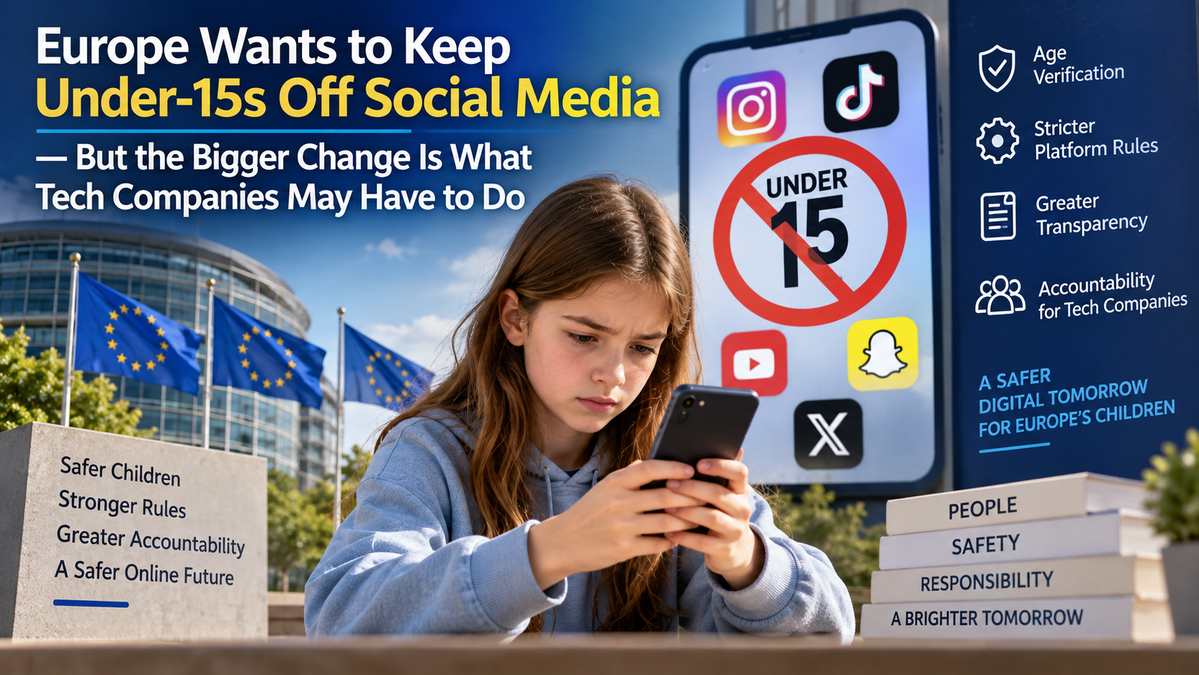
Europe is preparing one of its most ambitious attempts yet to change children’s relationship with the internet, with proposed rules that could prevent younger users from independently accessing social media while placing much greater responsibility on technology companies.
The European Commission is preparing an EU Kids Act that would introduce age-based rules covering social media and video-sharing platforms while imposing wider child-safety requirements on digital services including AI chatbots and online games.
Under the emerging proposal, children younger than 15 would not simply be able to open ordinary social-media accounts on their own.
But the proposal is about much more than choosing a minimum age.
Brussels wants to change the basic assumption that has governed children’s internet use for years: that a child can type a birth date into a box, click “continue” and enter an online environment largely designed for adults.
Instead, platforms could be required to verify age and provide different experiences according to the user’s age.
The End of “Just Enter Your Birthday”?
For years, one of the weakest points in online child protection has been obvious.
A platform asks for a date of birth.
A child enters a different year.
The account is created.
The European Commission has already highlighted this problem in its enforcement work. In April 2026, it preliminarily found that Meta had failed to adequately prevent children under 13 from accessing Facebook and Instagram, noting that users could enter a false birth date without effective checks establishing whether it was accurate.
The proposed EU approach attempts to move beyond that honor system.
Instead of trusting children to report their age accurately, online services could have to use more reliable age-assurance technology.
Different Ages, Different Levels of Access
The proposed system would not necessarily treat every person younger than 18 in exactly the same way.
According to draft details reported by Reuters and Euronews, the EU is considering a graduated system under which children’s access and protections would change as they grow older.
Very young children would receive the strongest protections.
Children between three and 12 could be limited to appropriate services operating through parent-controlled accounts.
Those aged 13 and 14 could potentially access introductory or restricted services with parental involvement.
From age 15, teenagers could create their own accounts, although platforms would still have child-safety obligations for minors.
The precise details remain subject to change before the legislation becomes law.
But the underlying principle is clear: a 10-year-old should not experience the internet in exactly the same way as a 17-year-old or a 30-year-old.
How Would Europe Actually Know Your Age?
This is where the proposal becomes technologically interesting.
Strict age limits are easy to announce.
Enforcing them without creating a giant identity database is much harder.
The European Commission has already developed an age-verification system designed to solve part of that problem.
Its technology can allow someone to prove that they have crossed a particular age threshold without giving the website their name, exact birth date or other unnecessary personal information.
Imagine showing a nightclub bouncer a digital card that says only “this person is old enough”, rather than handing over a document containing your address, birthday and other personal details.
That is broadly the principle behind the EU’s approach.
A person’s age could initially be established using sources such as an electronic national ID, passport, identity card or another trusted service.
The online platform would then receive proof that the user satisfies the required age threshold rather than receiving the person’s complete identity.
Europe Already Has the Technology
This part of the project is not merely theoretical.
The Commission released its initial age-verification blueprint in July 2025 and says the technology became feature-ready in April 2026.
It is designed to eventually work alongside the European Digital Identity Wallet.
The Commission says member states can customize the system while preserving its privacy features.
The technology can also be adapted to different thresholds.
So while one service might need proof that somebody is over 18, another could theoretically request confirmation that the person is 13 or older.
The EU expects age-verification solutions based on this framework to become available more broadly across member states by the end of 2026.
Social Media Is Only Part of the Plan
Another significant feature of Europe’s emerging approach is its scope.
The debate originally centered heavily on social networks such as Instagram, Facebook and TikTok.
But children’s digital lives no longer fit neatly into the category called “social media.”
Young people communicate inside games.
They watch algorithmically recommended videos.
They interact with AI chatbots.
They participate in virtual communities that can combine entertainment, communication and social networking.
The proposed EU Kids Act therefore looks beyond traditional social networks.
Online games and AI chatbots are also expected to face child-safety-by-design requirements.
That could make the legislation considerably more consequential than a conventional social-media age restriction.
Brussels Is Targeting the Design of Apps Too
Keeping younger children from creating unrestricted accounts addresses only one part of the problem.
Europe also wants to examine what happens after a child gets inside an app.
Draft proposals target design techniques that can encourage users to remain online for extended periods.
That includes features such as infinite scrolling, artificial notifications and certain reward mechanisms.
Recommendation algorithms could also face restrictions intended to prevent children from being pulled into endless “rabbit holes” of increasingly engaging or potentially harmful material.
This represents an important shift.
Instead of asking only, “Should this child be allowed on the platform?”, regulators are increasingly asking:
“What kind of platform should a child be allowed to experience?”
The Burden Could Shift From Parents to Platforms
Parents have traditionally carried much of the responsibility for managing children’s internet use.
Set screen-time limits.
Check their phones.
Monitor their accounts.
Explain online dangers.
The EU’s emerging approach does not eliminate that parental role.
But it attempts to place substantially more responsibility on the companies designing the digital environment.
Platforms could have to verify age, provide parental controls, make reporting harmful material easier and ensure that services used by minors are designed appropriately.
That is a fundamentally different regulatory philosophy.
Instead of expecting every family to defeat sophisticated engagement algorithms individually, regulators want companies to reduce some of the risks at the product-design level.
Privacy Could Become the Hardest Question
Age verification creates an obvious tension.
Protecting children requires platforms to know whether someone is a child.
Protecting privacy means platforms ideally should not collect unnecessary identity information about everyone.
Europe is attempting to achieve both goals through anonymous proof-of-age technology.
Under the Commission’s existing system, a platform can receive confirmation that somebody satisfies an age requirement without learning the person’s full identity.
That could address one of the strongest criticisms of mandatory age verification: that making the internet safer for children could inadvertently require adults to surrender more personal information.
Whether that approach works smoothly at the scale of hundreds of millions of users will be one of the major practical tests.
It Is Not Law Yet
Despite headlines describing an EU social-media ban, an important distinction remains.
The proposed EU Kids Act still has to go through the European legislative process.
The Commission’s proposal would need to be negotiated with EU member states and the European Parliament.
Those negotiations could change important details, including age thresholds, verification requirements and exactly which services fall within particular restrictions.
There is already debate over the appropriate minimum age.
The European Parliament has previously called for a harmonized digital minimum age of 16 for independent access to social media, video-sharing platforms and AI companions, while allowing younger teenagers access with parental consent.
The final European framework could therefore look different from today’s draft.
Europe Could Be Building a Different Internet for Children
The most important part of the proposal may ultimately have little to do with whether the cutoff becomes 15 or 16.
The larger change is the idea of an age-aware internet.
For much of the social-media era, adults and children have entered essentially the same platforms, encountered many of the same engagement systems and navigated similar recommendation engines.
Europe is moving toward another model.
Children could receive different accounts.
Different recommendations.
Different communication options.
Different time limits.
And different protections.
Age verification would become the gatekeeper making those distinctions possible.
That creates difficult questions about privacy, effectiveness and children’s access to information, and those issues will undoubtedly be debated as the legislation moves forward.
But Europe’s direction is becoming increasingly clear.
The EU is no longer satisfied with a digital doorway that simply asks children how old they are and trusts whatever number they type.
It wants technology companies to prove that their youngest users are protected — and potentially redesign significant parts of the internet to make that protection real.