

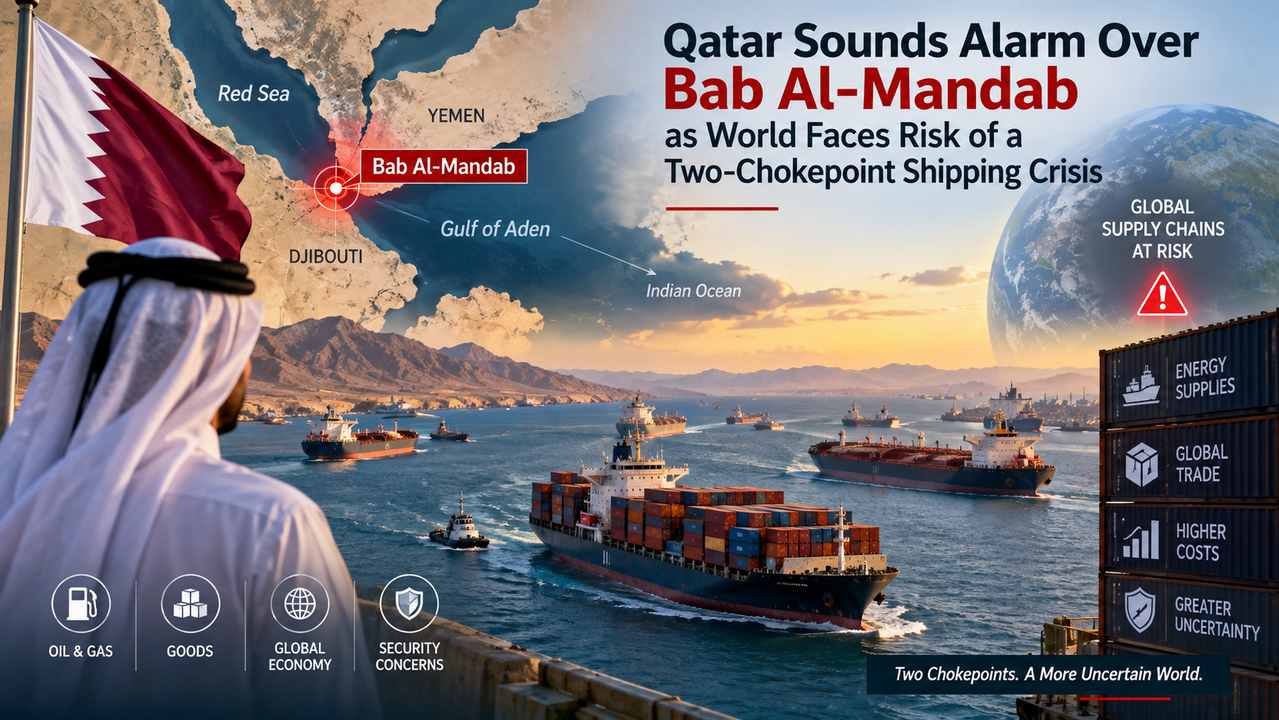
Qatar has issued a stark warning over the possibility of disruption at Bab Al-Mandab, arguing that the global economy can hardly afford another major maritime chokepoint to be compromised while the Strait of Hormuz is already facing serious disruption.
The warning comes amid renewed fighting in Yemen and recent Houthi advances along the country’s Red Sea coast, bringing fresh attention to one of the world’s most strategically important shipping passages.
For Qatar, however, the concern extends far beyond Yemen.
If Bab Al-Mandab were effectively closed to commercial shipping, the consequences could spread rapidly through oil markets, shipping networks and international supply chains.
The emerging danger is therefore not simply another Red Sea security crisis. It is the possibility that instability could simultaneously affect two of the Middle East’s most important maritime gateways.
Qatar Says the World Cannot Afford Another Closure
Ibrahim bin Sultan Al Hashmi, director of media and communication at Qatar’s Ministry of Foreign Affairs, addressed the issue during the ministry’s weekly briefing in Doha on September 15.
He warned that the economic consequences of existing disruption around the Strait of Hormuz were already significant.
Adding Bab Al-Mandab to that problem, he argued, could produce consequences on a much larger scale.
Qatar’s official position is that freedom of maritime navigation must be protected and that regional disputes should be addressed through diplomacy and negotiations.
Al Hashmi said Doha was continuing diplomatic efforts aimed at finding a peaceful solution to the crisis.
Why Bab Al-Mandab Matters
Bab Al-Mandab may look narrow on a map, but its importance is enormous.
The strait sits between Yemen on the Arabian Peninsula and Djibouti and Eritrea in the Horn of Africa.
It connects the Gulf of Aden and Indian Ocean with the Red Sea.
From there, ships can continue north toward Egypt’s Suez Canal and the Mediterranean.
In practical terms, it is one of the maritime bridges connecting Asian and Middle Eastern markets with Europe.
Oil tankers, container vessels and other commercial ships regularly travel through the passage.
A serious disruption would not necessarily stop global trade, but it could force many vessels to take much longer routes around Africa.
That means more sailing time, additional fuel consumption, higher freight expenses and potentially more expensive insurance.
The Bigger Problem Is Hormuz
Under ordinary circumstances, disruption at Bab Al-Mandab would already be a major international concern.
The current situation makes it potentially more consequential.
The Strait of Hormuz — another crucial maritime chokepoint — has been disrupted for months amid the wider regional conflict.
That has increased the importance of alternative export routes.
Saudi Arabia, for example, has been moving substantially larger quantities of crude through its Red Sea facilities.
Reuters-based analysis published in July reported that Saudi Arabia had diverted more than 70 percent of its normal daily crude exports toward the Red Sea port of Yanbu following disruption at Hormuz.
That makes the Red Sea route something like a pressure-release valve for the energy system.
If one major exit becomes unreliable, another route helps absorb the pressure.
The concern now is what happens if that second route is also squeezed.
A Two-Chokepoint Crisis
This is what makes Qatar’s warning particularly significant.
The global economy has dealt with maritime disruptions before. Ships can often reroute, companies can adjust supply chains and energy producers can search for alternative export arrangements.
But simultaneous pressure on Hormuz and Bab Al-Mandab would create a much more complicated problem.
Hormuz is crucial for Gulf energy exports.
Bab Al-Mandab is the southern gateway to the Red Sea and, ultimately, the Suez route.
Disruption at both would force companies to rethink some of the world’s most established trade corridors at the same time.
The effects could move beyond oil.
Container shipping, refined petroleum products and other cargo traveling between Asia, the Middle East and Europe could face longer journeys and higher transportation costs.
Those additional expenses can eventually work their way through supply chains.
Houthi Advances Increase Concern
The warning comes as Yemen’s Houthis have strengthened their position along parts of the country’s Red Sea coastline.
Their proximity to Bab Al-Mandab has raised concerns about maritime security.
The Houthis have previously demonstrated their ability to disrupt commercial shipping.
Beginning in late 2023, the group attacked vessels in and around the Red Sea, saying its campaign was linked to the war in Gaza.
Major shipping companies responded by diverting some vessels away from the Red Sea and around the Cape of Good Hope.
That experience demonstrated something important: a waterway does not necessarily have to be physically sealed to become commercially unattractive.
If missile or drone attacks make a route dangerous enough, shipping companies may decide that avoiding it is the safer option.
A Closure Is Not the Same as a Threat
There is also an important distinction in the current situation.
Bab Al-Mandab has not been established as completely closed to international shipping.
Qatar’s warning concerns the consequences if the waterway were closed or seriously disrupted.
That distinction matters because geopolitical warnings can easily become exaggerated as they spread across headlines and social media.
The immediate story is therefore about rising risk rather than a confirmed shutdown of the strait.
Nevertheless, previous Houthi operations in the Red Sea show why governments and shipping companies are treating that risk seriously.
Oil Markets Could Feel the Pressure
Energy markets would be particularly exposed to prolonged disruption.
Recent Reuters-based analysis found that petroleum flows through Bab Al-Mandab had increased considerably as the market adjusted to problems around Hormuz.
About 7.4 million barrels per day of petroleum passed through Bab Al-Mandab in June, according to Kpler data cited in that reporting, compared with approximately 4.2 million barrels per day a year earlier.
Those figures help explain why the strait has become even more strategically important.
If access became severely restricted, some tankers could sail around Africa.
But that solution comes with a price.
Longer journeys require more ships, fuel and time to transport the same amount of oil.
Asian refiners receiving Saudi crude through the Red Sea could face particularly significant delays if tankers were forced onto longer routes.
Shipping Costs Could Spread Through the Economy
Oil prices would be only one concern.
Modern supply chains depend on predictable shipping schedules.
When vessels are diverted thousands of additional kilometers, delays can ripple through ports, warehouses and manufacturing networks.
Freight rates can increase.
Marine insurance premiums may rise.
Companies may need larger inventories because shipments take longer to arrive.
Ultimately, at least some of those additional costs can reach consumers.
This is why a relatively narrow stretch of water between Yemen and the Horn of Africa can have consequences thousands of kilometers away.
Diplomacy Becomes Part of the Economic Response
Qatar’s response has focused heavily on diplomacy.
Its Foreign Ministry said the closure of waterways should not become normalized or regarded as acceptable and called for international support for freedom of navigation.
Doha has also been involved in diplomatic efforts surrounding the wider regional confrontation.
The message is that keeping shipping lanes open is not simply a military or maritime-security issue.
It is increasingly an economic priority.
When major trade routes become bargaining chips in regional conflicts, governments far beyond the Middle East can face the consequences.
The Strait That Has Become More Important
Perhaps the most important perspective on Qatar’s warning is that Bab Al-Mandab’s strategic value has changed because of what is happening elsewhere.
It was already one of the world’s critical shipping chokepoints.
But disruption at Hormuz has made it even more important.
The Red Sea has become a crucial alternative corridor for energy exports at precisely the moment when renewed fighting in Yemen is creating new uncertainty around its southern entrance.
That is why Qatar’s warning goes beyond another statement about regional tensions.
The danger is not simply that Bab Al-Mandab could face disruption.
It is that such disruption could arrive when the international energy and shipping system has fewer convenient alternatives available.
A crisis at one maritime chokepoint can often be managed through rerouting and adaptation.
A crisis involving two of them at once would be a very different test for the global economy.