

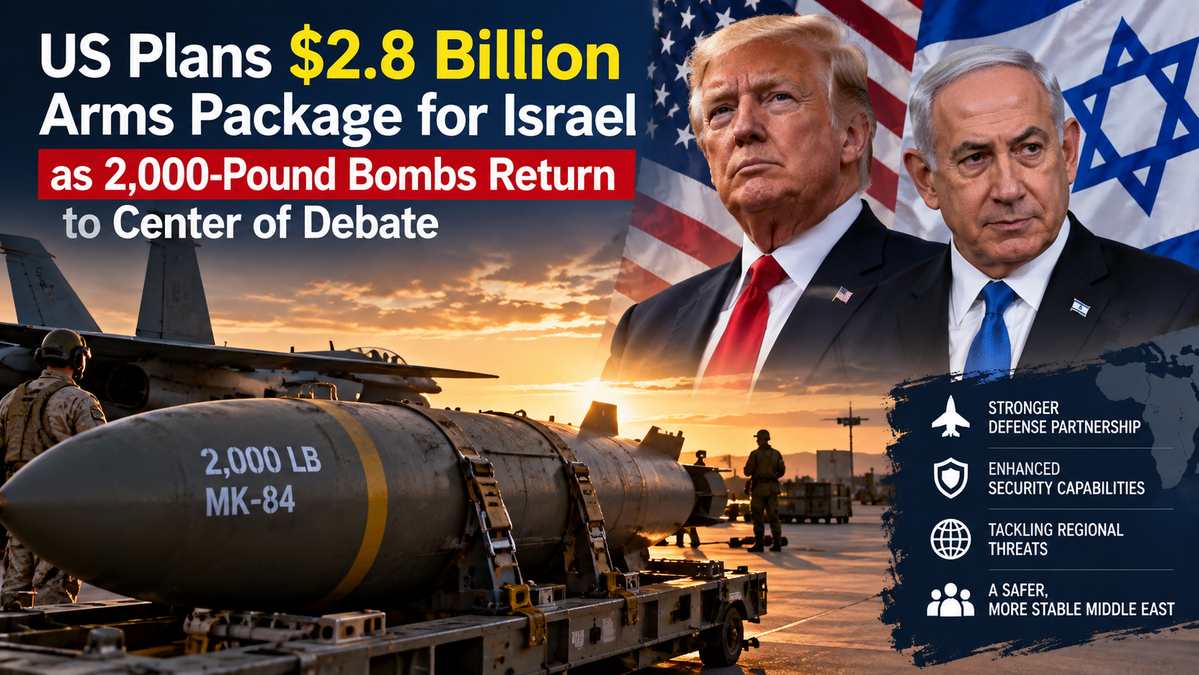
The Trump administration is preparing a proposed $2.8 billion munitions sale to Israel that could provide the country with tens of thousands of 2,000-pound bombs, bringing some of the most controversial weapons used in recent Middle East conflicts back to the center of the US-Israel relationship.
According to a US official familiar with the proposal, the package includes 20,000 MK-84 bombs and 20,000 BLU-117 bombs.
That would amount to 40,000 heavy bomb bodies in total.
The proposed sale has been informally communicated to the congressional committees that review major US arms transfers, Reuters reported. However, the package has not yet completed the process required for a final sale. The State Department and Israeli Embassy did not immediately comment on Reuters’ report.
The sheer number of bombs makes the proposal significant. But the bigger story may be what the package reveals about Washington’s military strategy toward Israel at a time when Israel’s operations in Gaza and elsewhere continue to generate intense international scrutiny.
What Are the MK-84 and BLU-117?
Both weapons belong to the 2,000-pound class of conventional bombs.
The MK-84 is a large general-purpose bomb designed for use against a variety of targets. The BLU-117 is another 2,000-pound general-purpose weapon broadly comparable to the MK-84, though there are differences in manufacturing and explosive filling.
Official US documentation describes the BLU-117 as a 2,000-pound free-fall weapon.
Weapons of this size can produce extensive blast effects, particularly when used in or near densely populated areas.
That is one reason the transfer and use of 2,000-pound bombs have become politically contentious.
Israel has previously used weapons of this class during operations in Gaza and Lebanon, attracting scrutiny from humanitarian organizations and weapons experts concerned about civilian casualties.
Why 40,000 Bombs Matter
The headline number tells only part of the story.
Supplying 40,000 heavy bombs would not merely replenish a small quantity of weapons consumed during recent operations. It could contribute substantially to Israel’s munitions inventory for future military operations.
The reported package therefore points toward a longer-term defense relationship rather than simply an emergency shipment responding to a single battle.
Most of the proposed purchase would reportedly be financed through US Foreign Military Financing, under which American funding enables eligible partner governments to purchase US defense equipment.
That financing structure also ensures that the proposed deal will remain a subject of debate in Washington.
Congress Has Entered the Picture
The proposal is not yet the same thing as a completed weapons transfer.
Relevant congressional committees have been informally notified about the package, according to Reuters.
Congress plays an oversight role in major US foreign military sales, although the precise process can depend on the type of transfer and circumstances surrounding it.
That means lawmakers now have an opportunity to scrutinize both the military justification for the package and its wider consequences.
Supporters of continued arms transfers to Israel generally emphasize the country’s security requirements and the longstanding US commitment to maintaining Israel’s military capabilities.
Critics have focused heavily on the humanitarian consequences of Israeli operations, particularly in Gaza, and have questioned transfers of large explosive weapons that may subsequently be used in densely populated areas.
The proposed sale brings those arguments back into direct confrontation.
The Biden-Era Bomb Dispute Still Looms Over the Deal
The political sensitivity surrounding 2,000-pound bombs is not new.
During the Biden administration, Washington paused a shipment of these heavy bombs amid concerns over their potential use in densely populated parts of Gaza.
After returning to office, President Donald Trump lifted the hold.
The policy reversal represented a clear change in how Washington approached restrictions on certain weapons deliveries to Israel.
The latest proposal would go much further in scale.
Instead of merely releasing weapons that had previously been delayed, the administration is now reportedly considering another enormous inventory of heavy munitions.
An Earlier Deal Helps Explain the Confusing Numbers
Some reporting surrounding the latest proposal has referred to 4,000 bombs, but that figure appears to stem from an earlier arms package.
In February 2025, the US Defense Security Cooperation Agency announced approval of a possible $2.04 billion sale involving 35,529 MK-84 or BLU-117 general-purpose bomb bodies, or a combination of the two.
That package separately included 4,000 I-2000 Penetrator warheads.
The newly reported proposal is different.
According to Reuters, it contains 20,000 MK-84s plus 20,000 BLU-117s, for a combined total of 40,000 2,000-pound bombs.
The distinction matters because confusing the two packages significantly understates the reported scale of the latest proposal.
Gaza Makes the Weapons Politically Sensitive
The debate surrounding these bombs cannot be separated from the Gaza war.
Israel launched its military campaign after the Hamas-led October 7, 2023 attacks, in which about 1,200 people were killed and more than 250 were taken hostage.
Israel has consistently described its military actions as necessary for self-defense and for combating Hamas.
At the same time, the enormous Palestinian death toll and destruction inside Gaza have generated growing international criticism.
Gaza health authorities say more than 73,000 Palestinians have been killed during Israel’s military campaign. A UN inquiry has accused Israel of genocide, an allegation Israel rejects.
Those competing claims and the continuing humanitarian consequences make the choice of weapons particularly consequential.
A 2,000-pound bomb may have legitimate military applications against certain targets, but its destructive radius makes its use in densely populated environments especially controversial.
US Public Opinion Is Also Changing
The proposed deal arrives as American attitudes toward US support for Israel have shifted.
A June 2026 Quinnipiac University poll cited by Reuters found that 48% of voters believed the United States was too supportive of Israel. Among Democrats, the figure was 66%.
Reuters noted that those numbers had risen considerably from when the question was first asked in 2017.
That does not determine whether the arms sale will proceed, but it provides important political context.
Weapons transfers to Israel are increasingly debated not only as questions of foreign policy but also as domestic political issues involving military aid, civilian protection and the appropriate limits of US support for allies.
The Package Extends Beyond Gaza
The strategic environment has also changed dramatically since the Gaza war began.
Israel has conducted military operations in Lebanon, while the United States and Israel carried out strikes against Iran in February 2026. Iran responded with attacks against Israel and Gulf states hosting US forces.
Against that background, Israeli demand for large inventories of air-delivered munitions can be viewed in a broader regional context.
The bombs could potentially form part of Israel’s capacity for future operations across multiple fronts.
That makes the package more than another Gaza-related arms shipment.
It is also part of a much larger question about how Washington intends to equip Israel as the Middle East’s security landscape changes.
More Than a Weapons Sale
The most revealing aspect of the proposed $2.8 billion deal may ultimately be its scale.
Twenty thousand MK-84s and another 20,000 BLU-117s represent a substantial potential addition to Israel’s heavy-munitions inventory.
For the Trump administration, the proposed package reflects continued military support for a longstanding US ally.
For critics of US arms transfers, the same package raises questions about civilian protection, accountability and whether weapons with such extensive destructive effects should continue flowing to a military operating in densely populated areas.
Those debates will follow the proposal through Washington.
The package has not yet become a completed sale, and congressional scrutiny remains part of the process.
But the numbers alone show why this proposal is attracting attention.
The story is not simply about 40,000 bombs. It is about the direction of the US-Israel military relationship — and how Washington is balancing Israeli security, regional conflict and mounting concerns over the human consequences of modern warfare.