

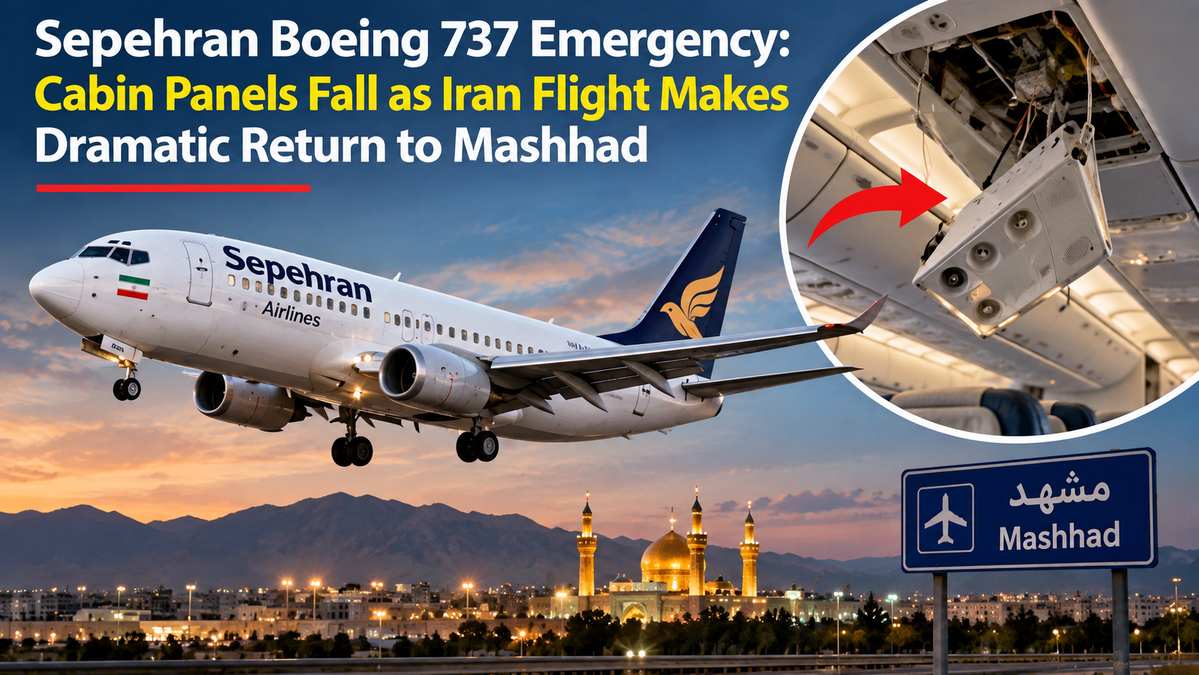
What began as a routine domestic flight across Iran turned into a frightening aviation emergency when a Sepehran Airlines Boeing 737 developed a landing-gear tyre problem shortly after departing Mashhad, forcing its pilots to abandon the journey and return to the airport.
Videos recorded inside the aircraft show the cabin shaking violently as sections of the ceiling lining came loose above passengers. Travelers can be heard shouting and praying while some appear to protect themselves from falling panels and belongings.
Despite the alarming scenes, the aircraft returned safely to Mashhad and no injuries were reported among passengers or crew.
The incident happened on September 15 as the Boeing 737 was operating a domestic service from Mashhad in northeastern Iran to Kermanshah in western Iran.
But beyond the dramatic footage, the emergency raises a more important question: what caused an apparently routine takeoff problem to produce vibrations severe enough to damage parts of the passenger cabin?
Trouble Begins During Takeoff
Initial reports described the emergency as beginning when one of the aircraft’s landing-gear tyres burst or became damaged during departure.
However, later reporting provided a more precise account.
Hassan Jafari, an airport official in Iran’s Khorasan Razavi province, reportedly told the ISNA news agency that the tread separated from one of the tyres during takeoff, rather than the entire tyre bursting.
The crew subsequently reported an engine problem and decided to return to Mashhad.
Other reports have suggested tyre debris may have contributed to engine damage, but aviation authorities had not publicly established the complete sequence of events at the time of reporting.
That distinction matters.
Early information following aviation incidents can change quickly, particularly when dramatic passenger videos begin circulating before investigators have examined the aircraft.
Violent Vibrations Transform the Cabin
For the people onboard, however, the technical distinction was probably the last thing on their minds.
Footage from inside the Boeing 737 shows intense shaking as passengers grip seats and brace themselves.
Then parts of the interior ceiling lining begin falling.
Sections above the passenger seats were left exposed, while overhead compartments reportedly opened and belongings fell into the cabin. Screams and prayers can be heard as passengers try to understand what is happening.
The images are dramatic, but they also reveal an important distinction: reports indicate that interior ceiling panels or lining became detached, rather than the aircraft’s structural roof collapsing.
That may sound like a minor wording difference, but in aviation reporting it is significant. A detached interior panel is very different from structural failure of the aircraft’s fuselage.
Pilots Abandon the Flight
With the aircraft experiencing technical problems, the crew abandoned the planned journey to Kermanshah and turned back toward Mashhad.
Emergency services were prepared as the Boeing 737 approached the airport.
The aircraft eventually landed safely.
Passengers and crew were able to leave the plane, and there were no reported injuries despite the frightening conditions inside the cabin. Travelers were subsequently transferred to another flight so they could continue to Kermanshah.
Mashhad’s runway was temporarily closed for inspection following the incident before reopening later that day.
The Video Tells Only Part of the Story
The most striking element of the incident is naturally the passenger footage.
Images of ceiling panels hanging above seats and frightened travelers shouting make the event appear catastrophic.
Yet the eventual outcome tells another side of the story.
The pilots were able to identify a serious technical problem, discontinue the flight and bring the aircraft back to the departure airport without reported injuries.
For aviation investigators, the more consequential questions will concern exactly what happened during takeoff.
Was the initial problem limited to tyre tread separation? Did debris subsequently damage an engine? What produced the severe vibrations? And why did those vibrations cause so much interior cabin material to become detached?
Those questions cannot be answered conclusively from passenger videos alone.
Second Recent Sepehran Incident at Mashhad
The emergency is particularly notable because it follows another incident involving a Sepehran Airlines Boeing 737 at the same airport only weeks earlier.
On August 25, a Sepehran Boeing 737-500 flying from Tehran to Mashhad veered from the runway after landing.
That aircraft was carrying 127 people, according to reports. Its nose landing gear collapsed after the runway excursion, but passengers and crew were reported safe.
Iran’s Civil Aviation Organization opened an investigation into that incident.
The two events are not evidence by themselves of a common underlying cause. They involved different circumstances — one occurred during landing, while the latest emergency developed around takeoff.
Still, their proximity means investigators and aviation authorities are likely to face increased scrutiny over maintenance, aircraft condition and operating procedures.
Iran’s Aviation Industry Faces Wider Challenges
The episode also occurs against the backdrop of longstanding challenges facing Iran’s commercial aviation sector.
International sanctions have complicated Iranian airlines’ ability to obtain Western-built aircraft, replacement parts and maintenance services. Al Jazeera noted those difficulties while reporting on the Sepehran incident.
That broader context should not automatically be treated as the cause of this particular emergency. Establishing why the tyre tread separated — and whether that event caused the reported engine problem — requires a technical investigation.
But the incident illustrates why aircraft maintenance and access to replacement components remain significant issues for Iranian aviation.
A Frightening Flight With a Safe Ending
For passengers, the technical investigation will come later.
Their experience was immediate: violent shaking, falling cabin panels, open overhead compartments and uncertainty about whether the aircraft would land safely.
Yet despite the extraordinary scenes captured on phones, everyone onboard reportedly escaped without injury.
That makes the Sepehran Airlines emergency a story with two very different sides.
The viral footage captures the fear inside the cabin. The safe return to Mashhad demonstrates how the flight crew responded when a routine domestic journey suddenly developed into an emergency.
The bigger story now lies with investigators.
Determining exactly why the landing-gear tyre suffered a tread separation, whether debris contributed to the reported engine problem and why the cabin interior sustained such extensive visible damage will be crucial to understanding whether this was an isolated mechanical failure or an indication of broader issues requiring attention.
Until those findings emerge, the dramatic videos show what passengers experienced — but not necessarily why it happened.