

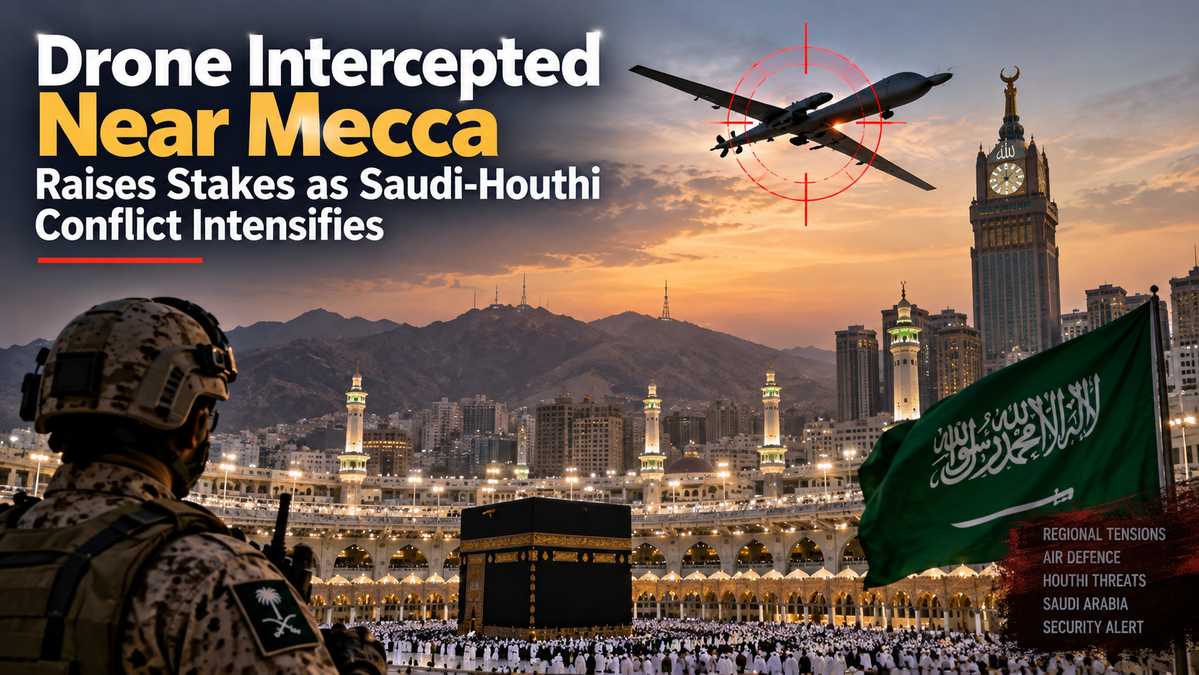
Saudi Arabia says its air defenses intercepted and destroyed a drone south of Mecca before it could enter restricted airspace around Islam’s holiest city, adding a highly sensitive new dimension to the rapidly escalating confrontation involving Yemen’s Houthis.
The incident occurred on Tuesday evening, September 15, according to the Saudi-led coalition fighting in Yemen. Coalition spokesperson Major General Turki al-Malki said the Royal Saudi Air Defence Forces destroyed the drone before it entered prohibited airspace over Mecca.
Saudi officials attributed the drone to the Houthis. The group, however, has rejected accusations that it targeted Mecca, creating sharply conflicting accounts of an incident that comes amid renewed fighting across the region.
Why Mecca Changes the Significance of the Conflict
Drone and missile interceptions have become an increasingly familiar feature of conflicts across the Middle East. But an incident involving Mecca carries a very different level of religious and political sensitivity.
Mecca is home to the Grand Mosque and the Kaaba, the focal point toward which Muslims around the world pray. Millions of Muslims also travel to the city for Hajj and Umrah.
That makes any perceived threat to the city far more than a conventional security incident.
Al-Malki said the protection of Islam’s two holiest mosques and pilgrims was a “red line” for Saudi Arabia. The coalition also indicated that it could take deterrent measures in response to further attacks.
The Saudi account described Tuesday’s interception as the second Houthi attempt to target Mecca, citing an alleged ballistic missile attack in July 2017.
Houthis Reject Saudi Allegation
The Houthis dispute Saudi Arabia’s version of events.
Houthi officials have denied targeting Mecca, with the group maintaining that Islamic holy sites are not among its targets. Houthi political bureau member Mohammed al-Farah described the allegation that the movement had targeted the city as false, according to reports citing the Houthi-run SABA news agency.
The disagreement is important because independently establishing the intended target of a drone during an active conflict can be difficult.
What Saudi authorities have confirmed is that their air defenses intercepted a drone south of Mecca before it entered the city’s restricted airspace. Saudi authorities attribute the aircraft to the Houthis; the Houthis deny that Mecca was its target.
Security Alerts Reach the Holy City
The interception came as Saudi Arabia activated security alerts across several locations following a series of attacks and escalating regional hostilities.
Alerts were issued in Mecca as well as Jeddah and other areas on Tuesday. Reuters reported that the Mecca warning was the first such alert in the holy city during the current conflict. The warnings were subsequently lifted.
That development illustrates how the geography of the confrontation is changing.
For years, Saudi-Houthi tensions were primarily viewed through the lens of Yemen’s civil war and attacks on Saudi border regions, airports and energy infrastructure. The possibility of threats approaching Mecca brings pilgrimage security directly into the broader regional crisis.
Saudi-Houthi Fighting Is Heating Up Again
The drone incident did not occur in isolation.
The Houthis have announced several attacks against Saudi targets during the past week, including an attack on an airbase on Monday. The group said those operations were retaliation for Saudi airstrikes in Yemen. Saudi coalition officials said the airbase attack wounded 13 civilians.
The renewed confrontation marks a significant reversal after years in which direct Saudi-Houthi hostilities had largely diminished.
Saudi Arabia intervened militarily in Yemen in 2015 after the Houthis seized the capital, Sanaa, and forced the internationally recognized government from power.
A United Nations-brokered truce introduced in 2022 significantly reduced cross-border attacks, although it did not produce a comprehensive political settlement.
Now that relative calm is being tested.
The Red Sea Is Becoming Part of the Story
Another reason the latest escalation matters is geography.
Houthi forces have recently expanded their position along parts of Yemen’s Red Sea coastline overlooking the Bab el-Mandeb Strait.
Bab el-Mandeb is one of the world’s most strategically important maritime passages, connecting the Red Sea with the Gulf of Aden and ultimately the Indian Ocean.
Its importance has increased as disruptions elsewhere in the region place greater pressure on alternative shipping and energy routes.
For Saudi Arabia, therefore, the renewed Houthi challenge is not simply about defending individual cities. It also involves protecting infrastructure and maritime routes that are vital to the kingdom’s economy and international energy markets.
A Security Incident With Religious Consequences
Perhaps the most important perspective on the Mecca interception is that its impact cannot be measured only by whether the drone caused physical damage.
Saudi air defenses say they stopped the aircraft before it entered restricted airspace, meaning the immediate threat was neutralized.
But the activation of an alert around Mecca demonstrates how regional warfare can reach places whose significance extends far beyond national borders.
Millions of Muslims visit Mecca throughout the year for Umrah, while enormous numbers arrive during the annual Hajj pilgrimage. Even a perceived threat to the city can therefore generate concern far beyond Saudi Arabia.
The Organisation of Islamic Cooperation, representing 57 Muslim-majority countries, condemned what it described as an attack against the holy city and expressed support for Saudi Arabia.
What Happens Next Could Matter More Than the Drone
The interception itself lasted only moments. Its political consequences could last considerably longer.
Saudi Arabia now faces the challenge of protecting its cities, religious sites, energy infrastructure and shipping interests while deciding how forcefully to respond to renewed Houthi operations.
The Houthis, meanwhile, continue to reject the claim that they deliberately targeted Mecca.
That leaves the region with two competing narratives but one unmistakable reality: the Saudi-Houthi confrontation is becoming more dangerous.
The most consequential development may therefore not be that a drone was destroyed south of Mecca. It is that a conflict once largely contained within Yemen and Saudi Arabia’s border regions is again expanding across strategically and religiously sensitive territory.
If attacks and retaliatory strikes continue, the security of pilgrimage routes, Red Sea shipping and Saudi infrastructure could increasingly become interconnected parts of the same regional crisis.